Summary The pigeon pose is one of the most practiced hip openings in yoga. It deepens the thighs and stretches the front


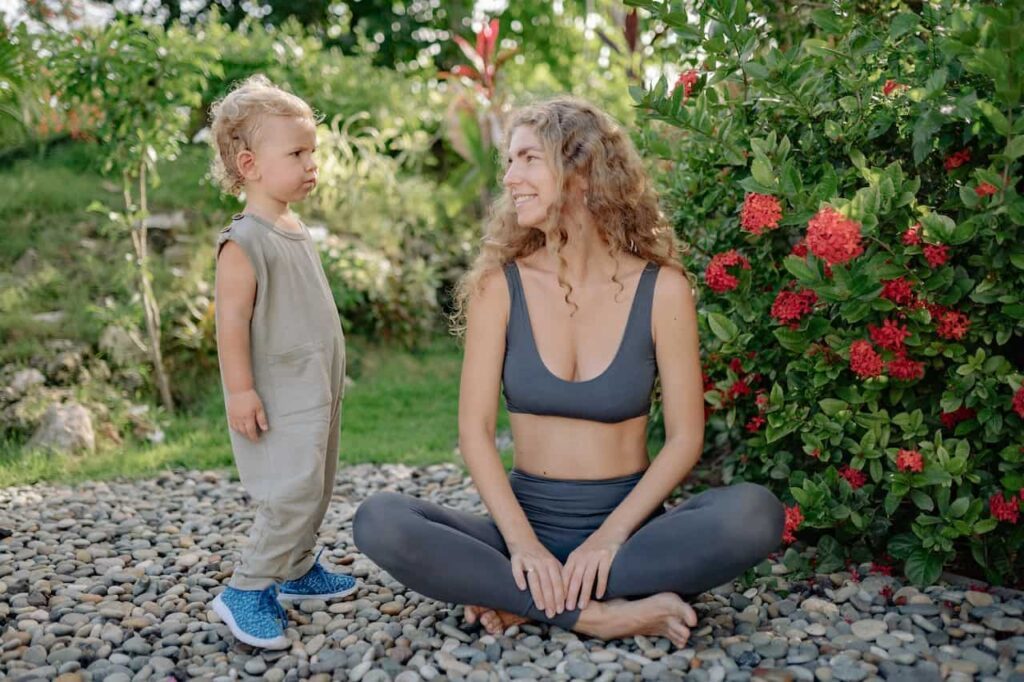
Child yoga is increasingly attracting parents looking for a gentle, joyful activity that is good for both the body and the mind. But what does a session look like, and at what age should it be started?
Child yoga is a playful version of yoga, adapted to the age and development of the child, which combines postures often inspired by animals, breathing exercises and relaxation time.
Here, there is no question of performance or perfect posture: the child moves, imitates, imagines, and learns to listen to his body. In this guide, we explain what yoga for children is, what its benefits are, how to make it playful through animal yoga, and how to adapt it for children aged 2 to 6. You will also find a simple session to do at home and our answers to the questions that parents most often ask.
Child yoga takes up the three pillars of adult yoga: postures (asanas), breathing and relaxation. The difference lies in the way they are conveyed. In children, everything revolves around play, imagination and movement.
The names of the poses are already very imaginative: the cat, the cobra, the tree, the mountain… A great opportunity to capture the attention of the youngest! The teacher, or the parent, does not correct the alignment to the millimeter. He or she invites the child to explore, to feel, and to have fun.
| Adult yoga | Child yoga | |
|---|---|---|
| Duration of a session | About 60 minutes | 5 to 45 minutes depending on age |
| Approach | Rhythm, precision | Games, stories, imitation |
| Postures | Took several breaths | Held for a few seconds, with noises |
| Objective | Strength, flexibility, relaxation | Motor skills, pleasure, managing emotions |
As in adults, yoga affects the body as well as the mind. In children, it mainly accompanies their development at their own pace.
Research is closely focusing on yoga for children. A meta-analysis published in 2025 in the journal Quality in Sport, which brings together nine studies and 285 children with ADHD, observes positive effects of yoga on inattention, emotional instability, and hyperactivity. However, it does not find a significant effect on anxiety. A study published in October 2025 in Frontiers in Psychology notes improved attention in young athletes after a children’s yoga program.
These results still need to be confirmed with larger groups. Yoga does not replace medical follow-up, but it can complement it gently. To go further, discover all the benefits of yoga. benefits of yoga for the body and the mind.
Child-friendly yoga is the key to successful practice. A child doesn’t hold a pose because they are asked to; they hold it because they become a lion, a tree, or a rocket. Here are three simple ways to turn a session into a game.
Invent a little adventure: a walk in the forest, a trip to the jungle, a day at the seaside. Each stage of the story brings a new attitude. You encounter a cat stretching its limbs, you climb a mountain, you hide like a little mouse. For 3-6 year olds, the story is enough. Around 7 years old, you can add some more specific instructions on posture.
These small games offer the child a valuable tool: their breathing can help them regain their composure when an emotion gets out of control.
Animal yoga is arguably the most natural gateway to child yoga. Many postures already have animal names, and children love imitating them, including the sounds they make! Here are six animals to bring to life with your child.
To end on a gentle note, suggest that your child roll into a ball like a turtle in its shell. This is the the child's posture, a classic at the end of a session to refocus and rest.
Child yoga for 2-year-olds still doesn’t look like a class. At this age, concentration only lasts a few minutes, and the child learns primarily through imitation. Yoga then becomes a moment of complicity between the parent and the child.
Your child is even younger? Discover our article on yoga for babies, another way to share a sweet moment from the very first months. Group classes become relevant from 3 years old, when the child can follow a group and simple instructions.
Around the age of 6, the child gains in concentration, balance and understanding of instructions. This is often the age when children’s yoga takes the form of a real class, with a beginning, middle and end.
Between 3 and 6 years old, we work on muscle development, motor skills and body coordination. The sessions are punctuated by stories and games. The child learns about animal postures, balance on one foot and the first breathing exercises.
From the age of 7, children can hold a posture for longer periods of time, perform several movements in succession, and become aware of the space around them. We introduce small sequences, postures in pairs, and a slightly longer guided relaxation. In pre-adolescents, starting at 12 years of age, yoga also helps them let go and better cope with school stress.
You don’t need a studio to get started: children’s yoga is very easy to do at home, on a mat or a towel. Here’s a typical 15-20 minute session, in four parts.
Do you want to entrust your child to trained teachers? With POSES Kids, We offer yoga classes for children on Wednesdays afternoon, in 45-minute sessions. The program includes playful postures and games to improve mobility and become aware of one's breathing.
| Age | Course theme |
|---|---|
| 3 to 6 years | Muscle awakening and motor skills |
| 7 to 11 years old | Apprehension of movement and space |
| 12 to 15 years old | Letting go and coordination |
To try it out, a discovery session is offered: visit the POSES Kids page to find out the prices and book your place.
A child can discover yoga as early as 2 years old, playing with a parent, in sessions of a few minutes. Group classes are suitable from 3 years old, when the child can follow a group. Around 6-7 years old, the practice becomes more structured.
At home, count 5 to 10 minutes by 2 years old, then 15 to 20 minutes starting at 3 years old. In a group class, a session usually lasts 30 to 45 minutes. At POSES Kids, the classes last 45 minutes.
Yoga can help a restless child channel their energy and focus better. A 2025 meta-analysis observed positive effects on inattention and hyperactivity in children with ADHD. Yoga remains complementary: it does not replace the guidance of a healthcare professional.
One session per week is enough to get started and creates a date that the child looks forward to. At home, a few minutes of breathing or a posture before going to bed can become a small daily ritual.
No. Children are often flexible, but that is not the goal. Child yoga primarily seeks the pleasure of movement, balance and breathing, without the pursuit of performance.
A flexible outfit in which the child feels comfortable (leggings, jogging pants, t-shirt) and bare feet so they don’t slip. At home, an anti-slip mat is useful, but a towel can be handy.
Child yoga is much more than a quiet activity: it is a playground where your child discovers their body, learns to breathe and to control their emotions.
Want to share this moment with other little yogis? Come and discover our yoga classes for children POSES Kids and offer your child a sweet and joyful break every Wednesday.