Contents Pilates is often perceived as a women's sport. Small group classes, flexibility, a gentle atmosphere... it's hard to



Yes, and often more than we think. Pilates works the muscles deeply, favouring slow and controlled contractions. For the arms, this translates into progressive toning, better firmness and a straighter posture.
A single Pilates exercise rarely engages just one muscle. When you perform a Pilates push-up, you work the triceps, biceps for stabilisation, shoulders, and core muscles at the same time. It is this integration that makes the method effective.
Weight training aims for hypertrophy: heavy sets that increase muscle volume. Pilates aims for muscular endurance and tone: precise movements that define and firm without adding bulk. For long, firm, and functional arms, Pilates is often the best choice.
What we can expect: More defined arms in 4 to 8 weeks with 2 to 3 sessions per week, improved shoulder posture, and a reduction in the feeling of flabby arms.
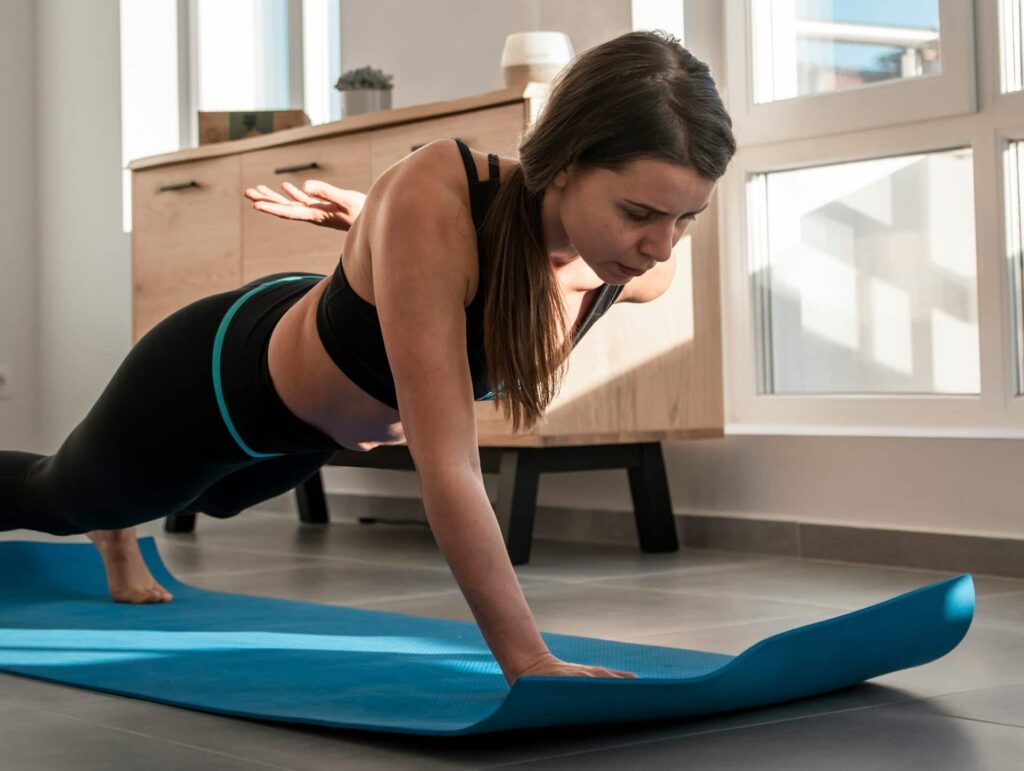
In a plank position, hands under shoulders, elbows close to the body (not splayed out). Lower yourself slowly for 3 counts, raise yourself for 1 count, contracting your triceps. The range of motion is reduced: lower yourself to within 5 cm of the floor, no more. Keep your hips aligned with your shoulders.
On all fours, raise one arm, elbow bent at a 90-degree angle, arm alongside your body. Slowly extend your forearm backwards until your arm is straight, contracting your triceps for one second, then return. Keep your elbow fixed; only your forearm moves.
Lie on your side with your legs straight. Place your top hand flat on the floor in front of your chest. Push down on this hand to lift your upper body, straightening your elbow. Slowly return. This movement effectively isolates the upper triceps.
Sitting, with legs extended, place your hands beneath your thighs, palms facing upwards. Attempt to flex your forearms as if performing a curl, but resist with the weight of your legs. Hold the contraction for 3 seconds, release, and repeat. A perfect exercise with no equipment.
Standing, feet parallel, arms extended in front of you at shoulder height, palms facing down. Draw small circles with a diameter of 15 cm with both arms at the same time, without moving your shoulders. The biceps and stabilising shoulder muscles work in isometric contraction.
Sitting balanced on the edge of the pool, legs straight, back straight. Extend your arms in front of you, palms facing upwards. Bring your elbows back towards your hips, contracting your biceps and your back muscles. Return slowly. This movement engages your biceps, back, and abdominal muscles.
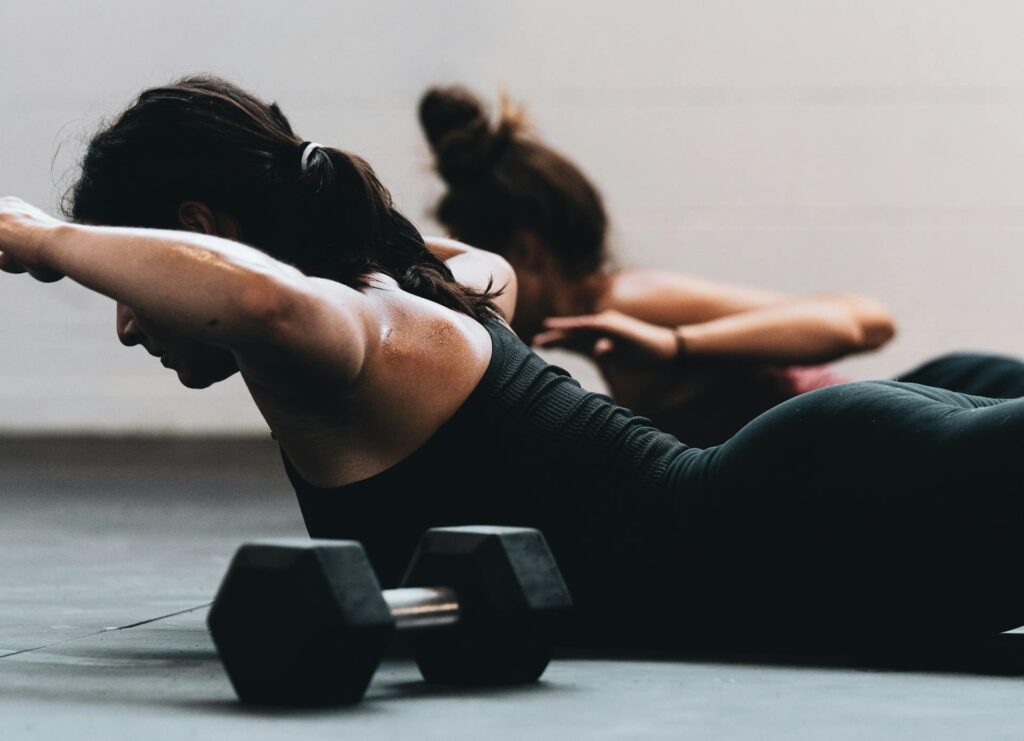
Lie on your front with your arms extended in front of you. Simultaneously lift your right arm and left leg, then alternate. Keep your gaze on the floor to protect your neck. This exercise strengthens the posterior deltoids and the lower back.
Standing with feet parallel, knees very slightly bent, back straight. Extend your arms down by your sides. Slowly raise them out to the sides to shoulder height, palms facing down, then lower them over 4 counts. Contract your shoulders at the top of the movement.
Lie on your side with your top arm raised towards the ceiling. Make small circles forwards, then backwards. Keep your arm straight; the movement should come from your shoulder. This exercise works the rotator cuff, which is often overlooked.
Here is a complete at-home routine, requiring no equipment. Warm up for 2 minutes: shoulder rotations, arm across chest, wrist circles.
Exercise | Details |
Pilates for push-ups | 3 x 8 reps, 45 sec rest |
Floor isometric curl | 3 x 12 repetitions, 30 sec rest |
Quadrupedal triceps extension | 3 x 10 repetitions per arm, 30 sec |
Standing arm circles | 2 x 10 circles in each direction |
Nageur | 3 x 10 repetitions, 45 sec rest |
Side opening | 3 x 12 repetitions, 30 sec rest |
Breathing: Breathe in through your nose before exertion, breathe out through your mouth during the contraction phase. Never hold your breath.
Alignment: Keep your shoulders low and relaxed, your wrists aligned with your forearms, and your stomach slightly tucked in. Poor alignment reduces effectiveness and can create tension.
This programme is designed to help you progress without getting injured. Plan for at least two rest days between each arm session.
Week | Objective and volume |
Weeks 1 and 2 | 2 sessions per week, 15-minute routine (6 exercises, 2 sets each) |
Week 3 | 3 sessions per week, change to 3 sets per exercise |
Week 4 | 3 sessions per week, add 2 reps per set, shorten rests |
After 4 weeks, the results are visible: your arms are more defined, your posture has improved and the exercises are performed with greater ease. It's time to increase the intensity or join a studio class.
Arms lose their firmness for several reasons: a sedentary lifestyle, hormonal changes, and loss of muscle mass with age. The good news is that muscle tissue can be strengthened at any age with the right exercises.
Recommended frequency: 2 to 3 Pilates arm sessions per week, with at least one rest day in between each. Below 2 sessions, progress is slow. Over 4 sessions without rest, the risk of muscle fatigue increases.
The first results generally appear in 4 to 6 weeks with regular practice. Firmness develops gradually, without a puffy effect.
Yes. Pilates strengthens arm muscles (triceps, biceps, shoulders) through slow, controlled contractions. It doesn't create significant bulk like heavy weight training, but it tones, defines, and improves firmness. For longer, more sculpted arms without bulking up, it's a particularly suitable method.
10 minutes a day can maintain a basic tone, but for visible results on your arms, aim for 20 to 30 minutes per session, 2 to 3 times a week. Consistency is more important than duration: two short, regular sessions are better than one long, occasional session.
The Pilates push-up is often considered the benchmark exercise, as it simultaneously engages the triceps, stabilising biceps, shoulders and abdominals. To specifically target the triceps, the quadruped extension is very effective. For the shoulders, the Swimmer yields excellent results.
Two to three sessions per week is the ideal rhythm for progress. Below that, results are slow. Beyond four sessions without rest days, the risk of muscle fatigue increases. Listen to your body: if your arms are sore the next day, allow yourself an extra rest day.
If you are looking for discipline athletic at a time gentle for the body and your health, and effective for working all your muscles, Pilates is an excellent option, especially if you are looking for a studio flat Pilates Paris 10.
At the house of POSES Studio, our classes are thoughtfully designed by experienced coaches, suitable for everyone, from seasoned athletes to beginners. Our clients particularly appreciate our tailored programmes.
Let yourself be enveloped by a soothing atmosphere and take a mental break during your session of Reformer Pilates in a studio in Paris.