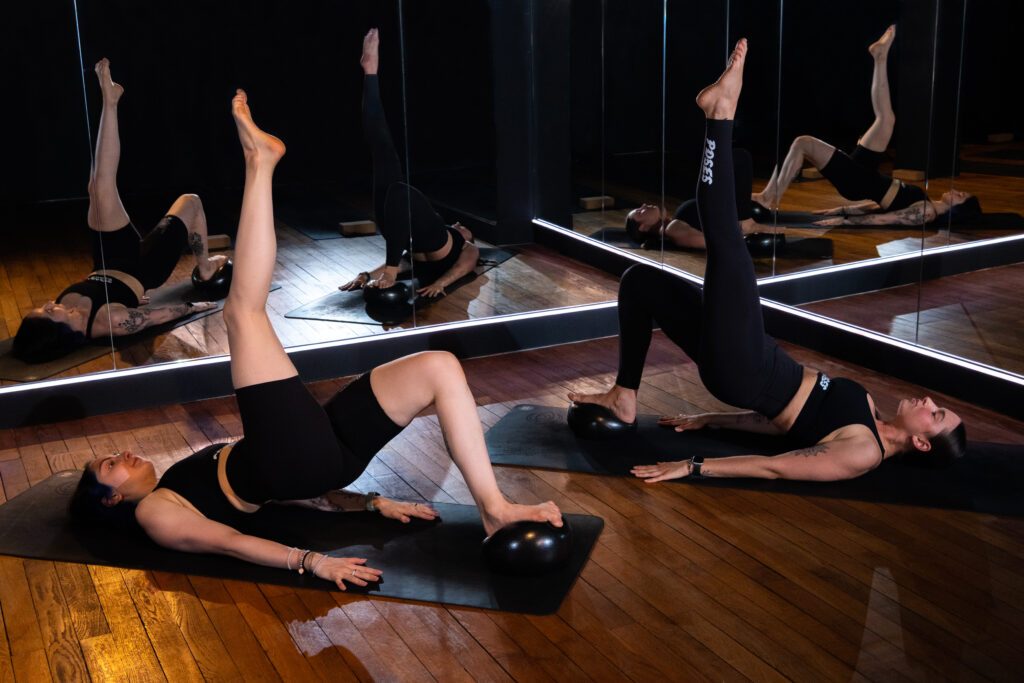
list of pilates exercises: women doing a pilates exercise

Here is a list of Pilates exercises, categorised by level: **Beginner Pilates Exercises:** * **The Hundred:** A foundational exercise that warms up the body, increases circulation, and builds core strength. It involves lying on your back, lifting your head and shoulders slightly, and pumping your arms up and down while breathing. * **Roll Up:** This exercise strengthens the abdominal muscles and improves spinal articulation. You start lying on your back and slowly roll your spine up towards your toes, then back down. * **Single Leg Circles:** Focuses on hip mobility and core stability. Lying on your back, you extend one leg towards the ceiling and draw circles with that leg. * **Rolling Like A Ball:** A gentle spinal massage that also strengthens the core. You sit with knees bent, hold your shins, and roll back and forth on your spine. * **Spine Stretch Forward:** Improves flexibility in the hamstrings and spinal extension. Sitting with legs extended, you reach forward, keeping your back straight. * **Saw:** A rotational exercise that works the obliques and improves spinal rotation. Sitting with legs extended and arms out to the sides, you twist and reach towards one foot. * **Swan Dive Prep:** Introduces back extension and strengthening of the back muscles. Lying on your stomach, you lift your chest slightly, keeping your pelvis grounded. * **Leg Pull Front (Plank version):** Builds core and shoulder strength in a plank position. **Intermediate Pilates Exercises:** * **Roll Over:** A more challenging progression of the Hundred and Roll Up, requiring greater abdominal strength and spinal control. * **Single Leg Stretch:** Works the abdominal muscles and improves coordination. Lying on your back, you bring one knee towards your chest while extending the other leg. * **Double Leg Stretch:** A more advanced version of the Single Leg Stretch, working the entire core. Both legs are extended away from the body and then brought back. * **Criss-Cross:** Targets the obliques and improves rotational strength. Lying on your back, you bring opposite elbows to opposite knees. * **Swan Dive:** A full back extension exercise that strengthens the back muscles and opens the chest. * **Leg Pull Front:** Strengthens the core, shoulders, and arms in a plank position, with the option to lift one leg. * **Side Kick Series (Front, Up, Down, Back):** Works the outer thighs, glutes, and core stability in a side-lying position. * **Teaser (Prep/Full):** A challenging exercise that builds significant core strength and balance. It involves lifting the torso and legs into a V-shape. * **Shoulder Bridge:** Strengthens the glutes, hamstrings, and back muscles, while improving spinal articulation. **Advanced Pilates Exercises:** * **Control Balance:** A highly advanced exercise requiring significant core strength, balance, and control, often performed on the reformer but can be adapted for mat. * **Jack Knife:** A challenging exercise that involves lifting the legs overhead and then returning them with control, strengthening the entire core. * **Pistol:** A very advanced single-leg squat that builds immense leg and core strength, alongside balance. * **Seal:** A playful but demanding exercise that strengthens the core, legs, and improves spinal fluidity. It involves jumping while clacking your feet together. * **Boomerang:** A challenging, flowing exercise that requires advanced core control and spinal articulation, similar to a more dynamic Teaser. * **Can Can:** Involves back extension and leg work in a prone position, demanding strength and control. * **Gideon:** A complex, multi-directional movement that challenges the entire body's coordination and strength. * **Full Teaser variations:** Advanced versions of the Teaser with added challenges like arm movements or leg extensions. Remember that this is a general guide, and the specific progression of exercises can vary depending on the instructor and individual capabilities. It's always recommended to work with a qualified Pilates instructor who can guide you through the appropriate exercises for your level.

Reading time : 7 min

You are looking for Pilates exercises effective for strengthening your body, improving your posture and gaining flexibility? Whether you're a beginner or already practice, there's a sequence to suit your level. Pilates is a gentle discipline that works the deep muscles, rebalances the body and reduces tension. And the good news: you can practice most of these exercises at home, with just a mat.

In this article, you'll find a complete list of Pilates exercises categorised by difficulty level, from beginner to advanced. Each movement is explained step-by-step, with recommended sets and repetitions. We start with the basics, then gradually increase the intensity.

Summary

The benefits of Pilates exercises

Pilates stands out for its ability to deeply work muscles that are often neglected by traditional sports. Deep abdominals, back muscles, hip stabilisers: these are what make the difference to posture and pain prevention.

Gentle muscle strengthening: Pilates targets the postural muscles without impacting the joints.

Improved posture : A more upright posture, relaxed shoulders, a well-placed pelvis.

Flexibility and mobility Fluid movements increase joint range and reduce stiffness.

Stress management Focusing on breathing helps to calm the nervous system.

Ideal addition to other sports: Running, weight training, swimming; Pilates strengthens stability and coordination.


The 5 fundamental principles of Pilates

Before starting the exercises, it is useful to understand the principles that underpin the method. Joseph Pilates had formalised a precise approach to movement, based on 5 essential pillars.

1. Breathing

Every movement is synchronised with a deep inhalation or exhalation. Breathing engages the abdominal muscles and oxygenates the tissues. In Pilates, we often inhale before the effort and exhale at the moment of contraction.

The centering

All movement originates from the «powerhouse»: the deep abdominals, pelvic floor, and lumbar muscles. Before each exercise, engage your core by gently drawing your navel towards your spine.

3. Concentration

Pilates is not an automatic practice. Each exercise demands total attention to movement, body position, and breathing. This is what distinguishes it from a simple gym session.

4. Control

Quality over quantity. It's better to perform 6 perfect repetitions than 20 sloppy movements. Muscle control protects joints and optimises results.

5. Fluidity

The movements flow smoothly and continuously, without jerks. The aim is a body that moves with grace and efficiency, not brute force.


Getting ready before starting exercises

A brief 5-minute warm-up is enough to prepare the body. Do arm circles, ankle rotations, and a few side bends. The goal is to mobilise the joints and activate circulation.

For most of the exercises on this list, you only need a non-slip mat. To take things further, a Pilates ball or ring can enhance certain sequences, but these are optional accessories.


Pilates exercises for beginners

These exercises are suitable for people who are new to Pilates or returning after a break. They work on the foundations: core strength, pelvic stability, body awareness.

The Double Leg Lift

This exercise strengthens the abdominal core and hip flexors. Perform 4 sets of 10 repetitions.

  • Lie on your back, arms by your sides, palms on the floor. Draw your navel towards your spine.
  • Raise both legs straight up, forming a 90-degree angle with the floor.
  • Inhale and slowly lower your legs towards the floor, without touching.
  • Exhale as you bring your legs up vertically. Keep your back flat on the floor throughout the exercise.


The Double Leg Stretch

A fundamental exercise for abs and mobility. Aim for 4 sets of 12 repetitions.

  • Lie on your back. Lift your torso up to the shoulder blades and bring your knees towards your chest, hands on your shins.
  • Inhale, stretching your legs forward and arms behind your head, body in a banana shape.
  • Exhale as you return to the starting position, chest lifted off the floor.


The Hundred

The iconic Pilates exercise. It strengthens the core and develops respiratory endurance. Goal: 100 arm pulses.

  • Lie on your back with your legs raised to 90 degrees and your arms 5 cm from the floor, along your body.
  • Lift your head and shoulders slightly. Engage your abs.
  • Perform small, rhythmic arm beats. Inhale over 5 beats, exhale over 5.
  • Repeat up to 100 beats in total.


The Roll Up

Excellent for stretching the spine and strengthening the abdominals eccentrically. Do 4 sets of 6 repetitions.

  • Lie on your back with your arms extended above your head and your legs stretched out on the floor.
  • Inhale, lifting your arms towards the ceiling. Exhale, slowly unfurling your spine to sit up, vertebra by vertebra.
  • Seated, gently lean your torso forward.
  • Inspire, then exhale, slowly rolling back to the floor.


The Neck Roll

Ideal for neck tension, and for strengthening the back and shoulders. Do 4 sets of 10 repetitions (5 on each side).
  • Lie flat on your stomach with your hands at shoulder height and elbows aligned with your wrists.
  • Push up on your arms to come up into a sphinx position. Squeeze your shoulder blades down your back.
  • Bring your chin to your chest, then slowly pivot to one shoulder as you exhale.
  • Return to the centre as you inhale, then pivot to the other side.

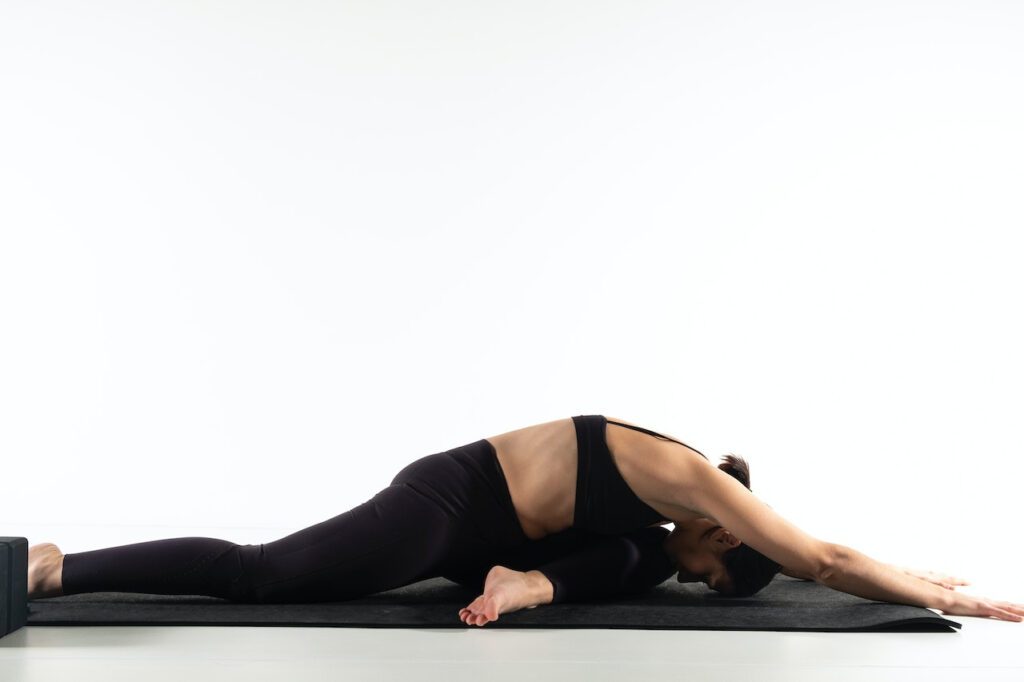
list of pilates exercises: a woman practises a pilates posture

Intermediate Pilates Exercises

These exercises require good body awareness and an already active core. If you have been exercising for less than 4 weeks, consolidate the previous exercises first.

The Criss Cross

Strengthen the obliques and abdominals by twisting the torso. 4 sets of 10 breaths.

  • Hands behind head, elbows out, knees to chest, torso raised.
  • Pivot your torso to the right, extending your left leg. Then alternate.
  • Inhale on one side, exhale on the other. The movement is continuous and fluid.


Swimming

A prone exercise that strengthens the entire posterior muscular chain and improves coordination. 4 sets of 30 seconds.

  • Lie on your stomach with your arms stretched out in front of you and your legs extended.
  • Engage your abdominal muscles by drawing your navel in without arching your back.
  • Lift your right arm and left leg up slightly at the same time. Alternate them quickly, as if you were swimming.
  • Inhale for 5 beats, exhale for 5. Keep your head in line with your spine.


The Side Kick

Tones the legs, hips, and obliques. 4 sets of 10 repetitions on each side.

  • Lie on your side, body aligned, head resting on your hand. The other hand is placed in front of you for balance.
  • Raise your top leg to hip height. Gently send it forward as you inhale, then back as you exhale.
  • Keep your torso still: only the leg moves. Repeat 10 times, then switch sides.


The Can-can

Strengthens the obliques, abdominals, and hip flexors. 4 sets of 10 repetitions.

  • Lean your torso back, resting on your elbows, with your legs together and bent.
  • Inhale as you tilt your legs to one side, then to the other.
  • Exhale as you tilt your legs to one side again and straighten them completely.
  • Alternate sides for each set.


The Double Leg Circle

Stretches the hamstrings and strengthens the hips and abs. 4 sets of 10 breaths.

  • Lie on your back. Raise your legs vertically, toes pointed.
  • As you exhale, lower your legs to one side, tracing a large circle.
  • On an inhale, bring the legs up to vertical on the other side.
  • Alternate the direction of the circles with each rotation. Keep your back flat on the floor.


Advanced-level Pilates exercises

These exercises require well-developed back and abdominal musculature. Do not attempt them if you have not firmly mastered the intermediate movements.

The Jack Knife

Demanding exercise that works core strength and spinal mobility. 4 sets of 6 repetitions.

  • Lie on your back with your legs extended and your arms by your sides.
  • Inhale as you lift your legs vertically. Bring them over your head into a shoulder stand position.
  • Exhale and hold the pose, engaging your abs, body straight.
  • Breathe in, then breathe out as you lower your legs forward and your spine down, vertebra by vertebra, to the floor.


The Teaser

The most recognisable move in advanced Pilates. It tests balance, abdominal strength and mobility. 4 sets of 6 repetitions.

  • Lie on your back with your legs extended and slightly raised, and your arms extended above your head.
  • Breathe in. As you breathe out, simultaneously lift your arms and legs to form a V with your body.
  • Arms extended towards the feet, body balanced on the tailbone.
  • Hold for 2 seconds, then inhale as you slowly return to the starting position.


Le Boomerang

Works hip stability, the back and the core. 4 sets of 10 repetitions.

  • Seated, legs extended and crossed at the ankles, torso leaning forward, backs of hands on the sides.
  • Inhale as you rock back, legs lifted above your head, parallel to the floor.
  • Cross your legs the other way. Put your arms behind your back, linking your fingers.
  • Exhale as you bring your torso forward and lower your legs. Repeat.


Hip Circles

Strengthens the thighs, obliques, abdominals and hip flexors. 4 sets of 10 repetitions.

  • Seated, arms extended behind you, torso inclined at 45 degrees, legs extended and joined.
  • Inhale, lifting your straight legs vertically.
  • Exhale as you lower your legs to one side, tracing a circle.
  • Inhale whilst lifting them up the other side. Alternate the direction of rotation.


Can these Pilates exercises be done at home?

Yes, the vast majority of these exercises can be done at home without any specific equipment. A non-slip mat is sufficient to get started. Pilates on the floor is a practice that can be done from your living room.

For beginners, two or three 20-30 minute sessions per week are enough to start seeing results. Regularity is more important than duration. It’s better to do 20 minutes three times a week than one hour-long session at the weekend.

If you wish to take it further, group classes in a studio offer valuable guidance. A coach corrects your posture in real-time, which speeds up progress and prevents compensatory movements.
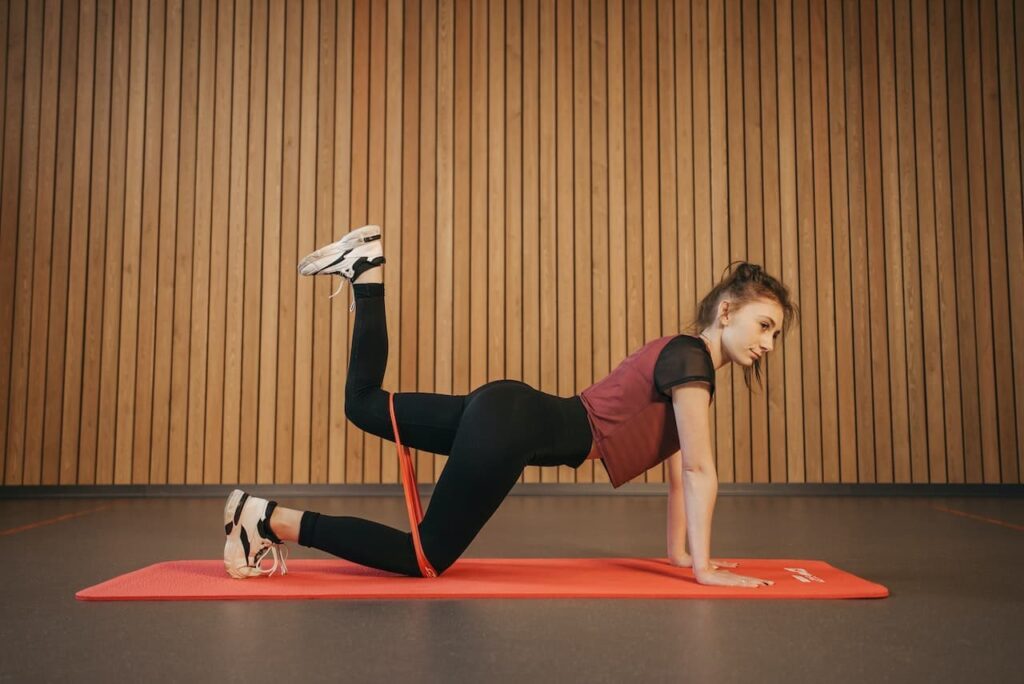
list of pilates exercises: a woman doing a pilates posture

Frequently asked questions about Pilates exercises

Les exercices de base du Pilates sont le "Hundred", le "Roll Up", le "Roll Over", le "Single Leg Circles", le "Rolling Back" et le "Single Leg Stretch".

The fundamental Pilates exercises are the Hundred, the Roll Up, the Double Leg Stretch and the Criss Cross. They work the deep abdominal muscles, breathing and pelvic stability. These are the first exercises to master before moving on to more complex movements.

Are 10 minutes of Pilates a day enough to see results?

10 minutes a day is a good start. You'll already feel an improvement in posture and a reduction in tension within a few weeks. For more visible results in muscle strengthening and body shaping, aim for 3 sessions of 30 minutes per week.

Can you do Pilates with scoliosis?

Yes, in most cases. Pilates is even recommended for strengthening the paravetebral muscles and relieving pain related to scoliosis. Some exercises need to be adapted according to the degree of curvature. Speak to your doctor and practice with a coach who knows your condition.

The 5 fundamental principles of Pilates are: * Centring * Concentration * Control * Precision * Breath

The 5 principles of the Pilates method are breathing, centering, concentration, control, and flow. They are detailed at the beginning of the article. These principles guide every movement and distinguish Pilates from a simple gym session.

Start Pilates at POSES 

You wish gain flexibility, refine your figure and improve your posture ? THE Pilates in Paris 8 will be your favourite sport for a gentle body workout! It's possible at POSES

Strengthen your body with pilates flow. Our Pulse&Pose® sequences are 50-minute sessions that mix isometrics, bodyweight exercises and strengthening. Furthermore, thanks to our movements, your deep muscles and balance are solidified. Take full advantage of the exercises that help you gain mobility, stability et strength under a dim light with some coaches who will take care to bring out the benefits of pilates on your body. 

Strengthen your body with a Pilates session at POSES