Contents Pilates is often perceived as a women's sport. Small group classes, flexibility, a gentle atmosphere... it's hard to



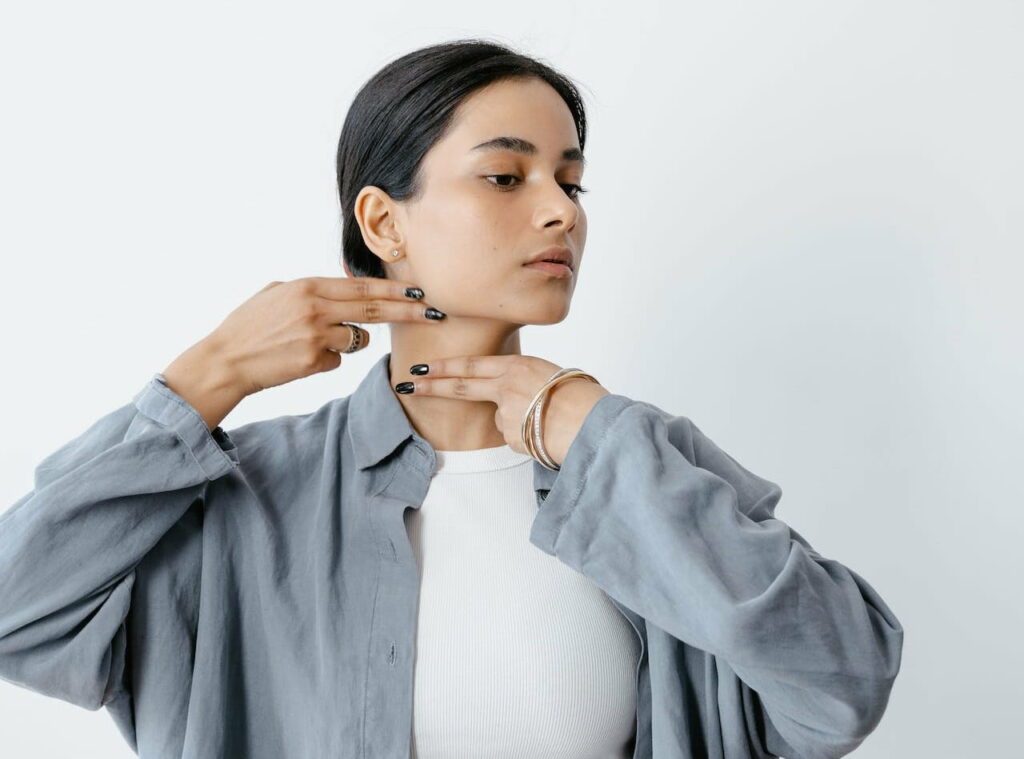
Face yoga is a gentle practice that helps to relax, tone and awaken the features. It is based on simple movements, breathing and listening to the face. Accessible to everyone, it easily integrates into a wellness routine.
In this article, you will understand what facial yoga is and how it works. You will discover its benefits, its principles, and the correct way to practise it. No unrealistic promises, no complicated movements.
Do you often have a tense, tired, or strained expression for no reason? Are you looking for a natural, simple, and coherent approach aligned with your well-being practice? This article is for you.
Face yoga is a gentle practice that combines Targeted movements, auto-massages et conscious breathing. The idea is simple: to move the facial muscles to tone them, relax them, and restore their mobility. Much like a yoga class, but for the face.
We're not talking about performance. We're talking about sensations. About presence. About that moment when you take the time to feel what's happening on your forehead, around your mouth, in your jaw. Facial yoga invites you to slow down and listen to this part of the body that we constantly use, without ever really taking care of it.
Facial yoga draws inspiration from several worlds. Traditional yoga, of course, with its strong link between breathing, posture, and body awareness. But also massage practices, certain Asian traditions, and gentle gymnastics.
The basic principle remains the same: less tension, more fluidity. We work with precise, slow, often repeated movements. We breathe. We relax. We observe. The face becomes a living space, not a frozen mask.
These two are often confused. However, the nuance is important.
Facial gymnastics focuses primarily on the muscle strengthening. The exercises are sometimes intense, very targeted, almost athletic. Facial yoga, on the other hand, seeks balance. It tones, yes, but without forcing. It relaxes as much as it activates.
Another key difference is breathing. In facial yoga, it guides the movement. It helps to release deep tensions, those that set in without warning. The result: a more supple, more expressive, and often... more relaxed face.
Face yoga helps to wake The facial muscles. With time, certain areas become fixed. The cheeks droop a little. The forehead tenses. The jaw clenches without warning. This practice restores movement where everything had become set.
By working gently, you stimulate the traffic, you restore tone and bring mobility. The face looks more alive. Fresher. Not transformed. Just better awakened.
The most commonly felt benefits:
Nothing spectacular. But something just.
The face doesn't exist in isolation. It takes on stress, fatigue, and emotions. Everything ends up showing there. Face yoga acts as a break. A real one.
By breathing, by relaxing the jaw or forehead, you send a clear signal to the body: we can let go. Many feel it quickly. Less tension. A sense of calm. Sometimes even a sigh that escapes on its own. You know the sort.
This is also a moment for you. No screens. No demands. Just a simple appointment, grounded in the body.
Let's be clear. Facial yoga does not promise an express facelift. It does not erase time. And it does not magically make a wrinkle disappear.
What it proposes, on the other hand, is a different relationship with your face. More conscious. Softer. More honest too. The results depend on regularity, attentiveness, letting go. Not on force or control.
Here, we don't seek to erase. We seek to to live His face. And that changes everything.
Facial yoga appeals to many people, but some individuals take to it immediately. If you already enjoy gentle practices, you'll recognise the sensation: that mix of precision, calm, and “ah yes, that was tense there.”.
You will find it genuinely interesting if:
And then there are those who come simply to relax. Not to “rejuvenate”. Just to stop carrying the day on their face. Frankly, that makes sense.
There is no official age. The right time is often when you say to yourself: “I feel tense” or “I look tired even though I'm not really that tired.” This can happen at 20 or 50.
In practice, you can start early to establish good habits:
And if you start later, it's just as useful. Muscles respond. So does the face. It's not a race. It's a practice.
Good news: facial yoga doesn't require a “typical” face. It adapts. You don't have to fit into a box. Nor do you need to aim for someone else's face.
Depending on your build, skin type, age, and expressiveness, you won't feel things in the same place. And that's normal. Some people feel everything in their jaw. Others around their eyes. Still others in their neck. No bug, promised.
The idea is to proceed with a simple rule:
You work with your face, not against it. And that, in itself, is a good start.
Face yoga isn't a case of “the harder I push, the better it works”. Quite the opposite. If you force it, you risk creating... tension. And that's precisely what we want to avoid.
Look for the accuracy. A light touch. A feeling of working, not fighting. The face responds better when you respect it.
And above all: consistency beats intensity. A few minutes, several times a week, is better than a big session and then nothing. A bit like Pilates. It's the small repetitions that make the difference.
Without breathing, the face tenses. It's automatic. You concentrate, you hold your breath, and *poof*: shoulders rise, jaw clenches, forehead furrows. Hello paradox.
Breathing serves as a guide. It helps you keep your face relaxed and release tension that builds up without you noticing.
A simple benchmark:
Yes, that's basic. And precisely, it works.
You see them all the time, especially at the start. And that's normal.
Classic pitfalls
The good sign is the feeling of gentle control. If you grimace as if you're imitating an emoji, you can slow down.
Facial yoga should remain comfortable. If you feel pain, it's not a challenge. It's a message. You adjust.
Adapt if:
In these cases, you favour relaxation and light movements. And if you have any doubts, you ask for a professional opinion. There's no need to play the hero.
Last point, and it's simple: clean hands, short nails, a clean face. It’s not glamorous, but your skin will thank you for it.
A facial yoga session can be short. Even very short. The idea isn't to block out 45 minutes in your bathroom as if you were going on a silent retreat.
For most people, a good landmark looks like this:
Beyond that, it's not “better”. The face tires quickly if you repeat too much. Maintain a sense of clean work, not overheating.
In the morning, facial yoga acts like a coffee... but for your features. You wake up circulation, boost energy, and smooth out your face. Perfect if you still look like you're in airplane mode.
In the evening, the effect is different. You come looking for relaxation. You let go of the day, you unclench your jaw, you smooth your brow. It's often then that you realise how much you were tensing up without knowing it.
You can also do an “in-between” version:
Two minutes are sometimes enough. Yes, really.
Your posture changes everything. If you do your exercises with your neck forward and shoulders tense, your face compensates. And it compensates strongly.
Make yourself comfortable.
Next, choose your vibe. Mirror or no mirror, music or silence, oil or dry skin. As long as you stay comfortable.
One last detail that makes all the difference: light. If you observe yourself, do so without looking for flaws. The goal isn't to judge yourself. The goal is to feel. And that, in itself, is already a lot.
The forehead is often the “reflex” zone. Are you concentrating? It furrows. Are you stressed? It tenses up. The goal here: relax without letting the face go into tension mode.
You can work in two stages:
The simple benchmark: if you create a crease during exercise, you lower the intensity. Yes, it's counter-intuitive. But it's in the rules of the game.
The eye contour is fine, sensitive, and very expressive. Here, the aim is not to “pull” or force the opening. The aim is to rest, relax.
What works well:
The trap: squinting. If you squint, you recreate tension. Keep your gaze relaxed, like when you smile with your eyes without any effort.
Cheeks are the “living volume” of the face. When they are toned, the face appears more awake. When they stiffen, it can seem closed or tired.
Here you will look for:
Think “small effort, good posture”. If you feel your jaw clenching, release and start again, more gently. Your cheeks work better when your jaw isn't stealing all the energy.
The oval is the area that changes a lot with tension and posture. Head forward, jaw clenched, tongue low… and the lower part of the face contracts.
The exercises for the oval aim to:
A useful landmark: the neck stays long, the shoulders stay low. If you push your chin forward like a turtle, you can recalibrate everything.
The neck is often forgotten, even though it carries part of the face. A tense neck often gives a tense face. It's logical.
Here, the goal is not to force a stretch. It is to:
You can alternate:
The good sign: a feeling of openness. The bad: tension or pain. In this case, you reduce, you breathe, you simplify. Always.
Face yoga integrates naturally into an existing practice. If you do yoga or Pilates, you know this principle: posture, breathing, precision. Here, it's the same logic, applied to the face.
After a body session, the face is often more receptive. The body has relaxed. Breathing is smoother. This is an ideal time for some targeted exercises. Conversely, facial yoga can also prepare you. It helps to focus your attention before moving.
Everything answers. Nothing opposes.
Good news: you don't need a sacred slot. Face yoga fits into real life. The one with schedules, unforeseen events, and sometimes zero motivation.
A few simple ideas:
These are not “perfect sessions.” They are useful moments. And often, they are the ones that last.
A good ritual is one you stick with, not one you admire on paper.
To start, keep it simple:
You can choose one area, then another. Alternate. Adapt according to your energy. Some days you'll feel like it. Others, you won't. And that's perfectly fine.
Face yoga doesn't need to be perfect to be effective. It just needs to be. Regularly. Quietly. Like a feel-good appointment, without pressure.
Face yoga is a gentle practice that helps to relax, tone and awaken the face. It relies on precise movements, breathing and listening to sensations. Accessible to everyone, it easily integrates into a wellness routine.
With regularity and gentleness, the face regains mobility and comfort. The effects are felt both on the features and on the inner state. Here, the aim is not to transform, but to naturally soothe and support.
If this topic resonates with you, other practices can complement this approach. Breathing, posture, Pilates or daily well-being rituals. So many avenues to explore to go further.