Summary Eye yoga is a set of gentle exercises that invite the gaze to move, blink, and rest at its own pace.


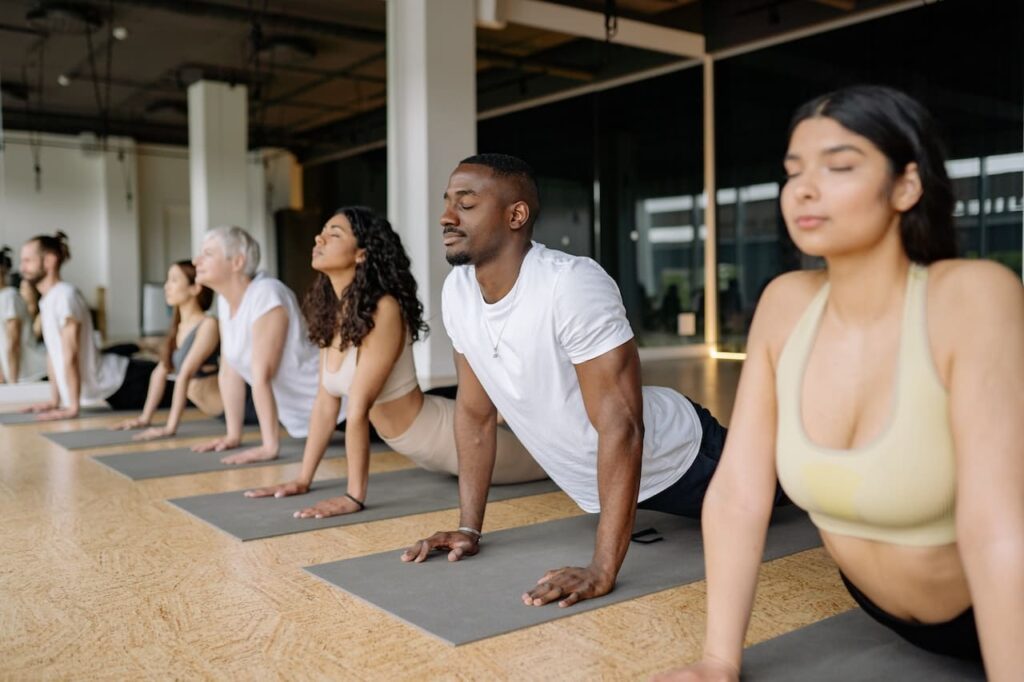
THE Hot yoga is a practice of yoga that takes place in a heated room, often damp, to work the body in the heat. You heard about it from a friend, saw courses on a schedule, and a question keeps popping up in your head: is this for you?
The promise has plenty to appeal to you. More supple muscles, a nice sweat, the feeling of having given everything in an hour. But the heat intrigues as much as it worries, especially when you’re starting yoga.
Good news: you don’t need years of practice to understand what awaits you. In this article, we sort through the common misconceptions and what the studies say. You’ll find a simple definition of hot yoga, the styles practiced in a heated room, the demonstrated benefits, and those that remain to be proven. We also review the precautions to know, the process of a first class, and the most frequently asked questions. So you can choose with confidence, at your own pace.
Hot yoga is not a separate style of yoga. It is a way of practicing: the postures remain those of yoga; only the room changes. It is heated, and the air is often more humid than in a traditional studio.
Heat has two immediate effects. The body heats up quickly, which leads to impression of flexibility from the very first poses. And you sweat a lot, even with simple combinations.
The term therefore covers very different courses. A slow class and a sports class can both be called hot yoga. Before booking, check the advertised style, duration, and level required.
There is no single rule: each studio sets its own temperature. Most classes take place between 32 and 41 °C, according to the Cleveland Clinic. The researchers, on the other hand, talk about hot yoga as soon as the room reaches 25 °C.
| Style | Room temperature | Duration of the course |
|---|---|---|
| Bikram Yoga | Around 40 °C, with 40% humidity | 90 minutes |
| Hot vinyasa or hot flow | Around 30 °C and above, according to the studio | 45 to 60 minutes most often |
| Hot power yoga | Around 30 °C and above, according to the studio | 45 to 60 minutes most often |
| Hot yin | Variable depending on the studio | 45 to 60 minutes most often |
For the first time, a less hot room and a shorter course are easier to live with.
Hot yoga originated in the United States in the 1970s. Bikram Choudhury, an Indian professor based in Los Angeles, had the idea of heating up his studio to recapture the warmth of his native country. His method, bikram yoga, the original form of hot yoga, consists of 26 positions, or asanas, and 2 pranayamas, and is spreading around the world.
Since then, many studios have kept the heated room and abandoned the imposed series. This is how the term hot yoga has become established to designate all practices in a heated room. To learn about the history and the progression of the original method, read our article on the subject. Bikram yoga.
Hot yoga, hot yoga, hot yoga: these three terms refer to the same thing. Behind this name, four major course families are based on schedules. They are inspired by the Different types of yoga which you may already know.
This is the most codified. Each class follows the same series of 26 postures and 2 breathing exercises, for 90 minutes, in a room at about 40 °C.
The advantage: you know what to expect and you measure your progress from session to session. The downside: it’s the most intense and longest form, so the most demanding when you’re starting out.
Here, the postures are linked to the rhythm of the breath, just like in a yoga class. vinyasa yoga. The sequences change from one course to another, often to music.
The heat is generally milder than in Bikram. It is one of the most common formats in hot yoga studios, and the closest thing to a traditional dynamic yoga class.
A sporty version of hot yoga, it focuses on strengthening: boards, chairs, quick circuits. It follows the same codes as the traditional version. power yoga, With the heat on top of that.
Cardio gets up to speed quickly. It’s better to have already taken a few yoga classes before trying it out.
In contrast, Yin Yoga offers floor-based postures held for several minutes in a gentle practice inspired by Chinese medicine. The heat helps to release tension without cardio effort, making it a particularly suitable option at the end of the day. If you’re unsure between a slow approach and a more rhythmic practice, this also helps to situate Yin Yoga in relation to Ashtanga or Kundalini.
Heat has also taken hold in other disciplines. Hot Pilates, for example, applies the same principle to Pilates exercises.
Hot yoga has been the subject of a Scientific review published in 2025 in Sports Medicine - Open. It brings together 43 studies and 942 participants. Its conclusions are encouraging, with some useful nuances.
Practiced every week, hot yoga improves Flexibility, balance and strength. Studies also show a positive effect on bone density. These are the best documented benefits.
In the room, the warmth gives the feeling of going deeper into the postures. It’s pleasant, provided you listen to your body to avoid injuries during stretching in a hot environment: we’ll return to this topic later.
During a class, body temperature and heart rate increase more than in a traditional classroom setting. The effort therefore appears more intense.
Over several weeks, the researchers observed favorable effects on body composition and on the lipid levels in the blood.
Like any yoga practice, hot yoga combines movement, breathing, concentration, and well-being. Many practitioners describe an experience of letting go. Studies on mood and stress are also in this vein, but their results remain to be confirmed.
In short: the benefits come first from the yoga itself. The heat changes sensations; the results remain close to the same.
For a healthy person, hot yoga is a safe practice in the vast majority of cases. However, the heat does require some precautions.
There Mayo Clinic does not recommend hot yoga in the following cases:
Ask your doctor’s advice before starting if you are pregnant, if you suffer from hypertension or asthma, or if you have a health problem.
Dizziness, spinning head, nausea, headache, difficulty breathing: at the slightest of these signs, stop what you are doing. Sit down or lie down on your mat, then drink a few sips.
If the discomfort persists, leave the room. There is no shame in taking a break: the teachers are used to it.
Breathe in through your nose, at your own pace. Drink small sips between each position.
Don’t try to keep up with your neighbors: everyone moves at their own pace. During the first class, staying in the room until the end is already a success. If a pose seems too intense for you, rest in the child’s pose, then resume when you feel ready to. No matter the type of class you are taking, the teacher can give advice and provide answers tailored to each person. A well-chosen playlist can also support the atmosphere during the session. In other formats, Hot Pilates is a discipline that combines HIIT and Pilates methods in a heated room.
Take the time for the final relaxation, then continue drinking for the following hours. You may feel tired the same evening. Give your body one or two days of rest before starting again.
Both practices rely on the same postures. What changes is the comfort and the learning potential.
| Criterion | Hot yoga | Yoga in an unheated room |
|---|---|---|
| Sensation of effort | Elevated: the heat adds to the movement | Modifiable according to style |
| Learning postures | More delicate: the heat is tiring and distracting | It's simpler: you stay focused on the gesture |
| Hydration | To be monitored before, during and after | Normal needs |
| Contraindications | Several (heart, pregnancy, intolerance to heat) | Few in number |
| Demonstrated benefits | Flexibility, strength, balance | Flexibility, strength, balance |
If you have never practiced yoga before, start with a few basic classes. This is also the advice of the Cleveland Clinic: you learn the postures and identify your limits before adding heat.
Want to sweat and get your body moving right now? A dynamic yoga class is all you need. At POSES, the Yoga Flow It combines postures and transitions inspired by vinyasa, with strengthening sequences, in 50 minutes. A way to work up your stamina, whatever your level.
Not unlike other forms of yoga. The weight lost immediately after a class corresponds to the water expelled by sweating, and it returns as soon as you drink it. A 2025 scientific review shows that a session in a heated room does not consume more energy than a traditional session. However, practiced every week, hot yoga can complement an active lifestyle.
Bikram yoga is a form of hot yoga, the first to have existed. It imposes a fixed series of 26 postures, a 90-minute class, and a room at about 40°C. Hot yoga combines all practices in a heated room, with styles, durations, and temperatures that vary from studio to studio.
Yes, provided you choose a class advertised as accessible, in a room with moderate heat. The ideal option is to learn the postures in a traditional yoga class, then try the heated room. Always inform the teacher that you are just starting out.
Start with one session per week, until your body gets used to the heat. You can then increase to two or three sessions if you feel comfortable. In studies, participants practice between two and six times per week.
Hot yoga is not recommended during pregnancy, according to the Cleveland Clinic. Talk to your doctor or midwife about it, and seek prenatal yoga, which is practiced in an unheated room.
Water, in sufficient quantities throughout the day. As for meals, aim for a snack or light meal two to three hours before the class. Avoid large meals, as they make the heat more difficult to bear.
Hot yoga involves practicing yoga in a heated room. Bikram, hot vinyasa, hot power yoga or hot yin: the styles vary, as do the temperature and duration of the classes.
Its benefits for flexibility, strength, and balance are real. However, studies do not show that it is better than traditional yoga or that it burns more calories.
Remember three reflexes: drink plenty of water, move at your own pace and stop if you feel unwell. In case of a health problem or pregnancy, ask your doctor for advice.
And if you’re just starting out, there’s no rush. A few dynamic yoga classes will give you a solid foundation for the rest.
Want to move, strengthen, and breathe? POSES Yoga Flow combines the postures, movements, and transitions of vinyasa into a 50-minute class designed for all levels. You gain mobility, strength, and fluidity with each session.
Book your First session at POSES in one of our studios.